Home / Publications / Арил(окси)(сульфанил)(сульфонил)ацетаты гуанидиния. Синтез, строение, анализ биологической активности

Арил(окси)(сульфанил)(сульфонил)ацетаты гуанидиния. Синтез, строение, анализ биологической активности

С. В. Лукьянова 1
С. В. Лукьянова
Н. А. Войченко 1
Н. А. Войченко
Н. Г. Гефан 1
Н. Г. Гефан
Е. Н. Оборина 2
Е. Н. Оборина
С. Н. Адамович 2 *
С. Н. Адамович
1 Иркутский научно-исследовательский противочумный институт Сибири и Дальнего Востока Роспотребнадзора
Published 2025-12-10
Share
Cite this
GOST
 | 
Cite this
GOST Copy
Лукьянова С. В. et al. Арил(окси)(сульфанил)(сульфонил)ацетаты гуанидиния. Синтез, строение, анализ биологической активности // Russian Chemical Bulletin. 2025. Vol. 75. No. 2. pp. 594-600.
GOST all authors (up to 50) Copy
Лукьянова С. В., Войченко Н. А., Гефан Н. Г., Оборина Е. Н., Адамович С. Н. Арил(окси)(сульфанил)(сульфонил)ацетаты гуанидиния. Синтез, строение, анализ биологической активности // Russian Chemical Bulletin. 2025. Vol. 75. No. 2. pp. 594-600.
RIS
 | 
Cite this
RIS Copy
TY - JOUR
UR - https://russchembull.colab.ws/publications/82
TI - Арил(окси)(сульфанил)(сульфонил)ацетаты гуанидиния. Синтез, строение, анализ биологической активности
T2 - Russian Chemical Bulletin
AU - Лукьянова, С. В.
AU - Войченко, Н. А.
AU - Гефан, Н. Г.
AU - Оборина, Е. Н.
AU - Адамович, С. Н.
PY - 2025
DA - 2025/12/10
PB - Известия Академии наук. Серия химическая
SP - 594-600
IS - 2
VL - 75
ER -
BibTex
 | 
Cite this
BibTex (up to 50 authors) Copy
@article{2025_Лукьянова,
author = {С. В. Лукьянова and Н. А. Войченко and Н. Г. Гефан and Е. Н. Оборина and С. Н. Адамович},
title = {Арил(окси)(сульфанил)(сульфонил)ацетаты гуанидиния. Синтез, строение, анализ биологической активности},
journal = {Russian Chemical Bulletin},
year = {2025},
volume = {75},
publisher = {Известия Академии наук. Серия химическая},
month = {Dec},
url = {https://russchembull.colab.ws/publications/82},
number = {2},
pages = {594--600}
}
MLA
Cite this
MLA Copy
Лукьянова, С. В., et al. “Арил(окси)(сульфанил)(сульфонил)ацетаты гуанидиния. Синтез, строение, анализ биологической активности.” Russian Chemical Bulletin, vol. 75, no. 2, Dec. 2025, pp. 594-600. https://russchembull.colab.ws/publications/82.

Keywords

арилхалькогенилацетаты гуанидиния
арилхалькогенилуксусные кислоты
биологическая активность
гуанидин
ингибиторы
патогенные бактерии
стимуляторы

Abstract

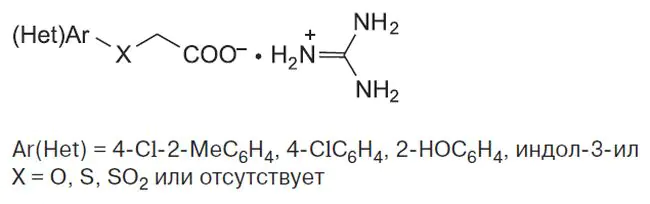
Взаимодействием арилхалькогенилуксусных кислот 1a—e и карбоната гуанидиния 2 синтезированы арилхалькогенилацетаты гуанидиния 3a—e общей формулы ArXCH2COO•H2+N=C(NH2)2, где X = O, S, SO2 или отсутствует. Строение синтезированных соединений установлено с помощью ИК-спектроскопии и спектроскопии ЯМР 1H и 13C. Расчеты in silico свидетельствуют о том, что соли 3a—e обладают синтетической и биологической доступностью, подобием лекарств, могут эффективно (до 89%) ингибировать активность некоторых ферментов, не обладают иммуно-, цитотоксичностью и мутагенностью (вероятность до 99%), а также практически безвредны (LD50 500 мг•кг–1). Изучено влияние солей 3a—e на рост ряда патогенных бактерий (листерий (Listeria monocytogenes), стафилококков (Staphylococcus aureus), иерсиний (Yersinia enterocolitica, Yersinia pseudotuberculosis, Yersinia pestis) и холерного вибриона (Vibrio cholerae)) in vitro. В высоких концентрациях соли 3a—e оказывают умеренное ингибирующее действие (до 40—50%) на рост микроорганизмов, тогда как в низких концентрациях они проявляют значительную стимулирующую активность (до 82%). Активность солей 3a—e зависит от их строения и состава: максимальная активность наблюдается при ArX = 4-ClC6H4S, 4-ClC6H4SO2 и индол-3-илсульфанил. Серосодержащие соединения улучшают специфическую активность питательных сред, в частности, увеличивают показатель прорастания тест-бактерий (до ∼ 200%).

References
1.
Advances in Biomass and Microbial Lipids Production: Trends and Prospects
Costa G.D., Martinez-Burgos W.J., dos Reis G.A., Puche Y.P., Vega F.R., Rodrigues C., Serra J.L., Campos S.D., Soccol C.R.
Processes, 2024
2.
Multimodal Role of Amino Acids in Microbial Control and Drug Development
Idrees M., Mohammad A.R., Karodia N., Rahman A.
Antibiotics, 2020
3.
Yersinia pestis and plague: an updated view on evolution, virulence determinants, immune subversion, vaccination, and diagnostics
Demeure C.E., Dussurget O., Mas Fiol G., Le Guern A., Savin C., Pizarro-Cerdá J.
Genes and Immunity, 2019
4.
Пат. RU 2360901; Бюл. изобрет., 2009, № 19
5.
Discovery and in Vivo Evaluation of Macrocyclic Mcl-1 Inhibitors Featuring an α-Hydroxy Phenylacetic Acid Pharmacophore or Bioisostere
Rescourio G., Gonzalez A.Z., Jabri S., Belmontes B., Moody G., Whittington D., Huang X., Caenepeel S., Cardozo M., Cheng A.C., Chow D., Dou H., Jones A., Kelly R.C., Li Y., et. al.
Journal of Medicinal Chemistry, 2019
6.
Design and synthesis of 2-((1H-indol-3-yl)thio)-N-phenyl-acetamides as novel dual inhibitors of respiratory syncytial virus and influenza virus A.
Zhang G., Li Q., Zhao J., Zhang X., Xu Z., Wang Y., Fu Y., Shan Q., Zheng Y., Wang J., Zhu M., Li Z., Cen S., He J., Wang Y., et. al.
European Journal of Medicinal Chemistry, 2020
7.
Biological importance of the indole nucleus in recent years: A comprehensive review
Sharma V., Kumar P., Pathak D.
Journal of Heterocyclic Chemistry, 2010
9.
Hydroxyalkylammonium salts of organylsulfanyl(sulfonyl)acetic acids—New stimulators of biological processes
Mirskova A.N., Levkovskaya G.G., Mirskov R.G., Voronkov M.G.
Russian Journal of Organic Chemistry, 2008
10.
Atranes as a new generation of biologically active substances
Voronkov M.G., Baryshok V.P.
Herald of the Russian Academy of Sciences, 2010
12.
New atranes and similar ionic complexes. Synthesis, structure, properties
13.
Protatranes, effective growth biostimulants of hydrocarbon-oxidizing bacteria from Lake Baikal, Russia
Pavlova O.N., Adamovich S.N., Novikova A.S., Gorshkov A.G., Izosimova O.N., Ushakov I.A., Oborina E.N., Mirskova A.N., Zemskaya T.I.
Biotechnology Reports, 2019
14.
Synthesis, structure and biological activity of hydrometallatranes
Adamovich S.N., Ushakov I.A., Oborina E.N., Vashchenko A.V., Rozentsveig I.B., Verpoort F.
Journal of Molecular Liquids, 2022
15.
Tris(2-hydroxyethyl)ammonium-Based Protic “Ionic Liquids”: Synthesis and Characterization
Tojo E., Cáceres A., Somoza A., Pena C.A., Soto A.
Journal of Chemical & Engineering Data, 2024
16.
From alkanolamines to protic alkanolammonium ionic liquids
17.
Effect of protatranes on the biosynthesis of extracellular enzymes of Candida ethanolica BKM Y-2300 T
Kiryukhina A.S., Lozovaya T.S., Adamovich S.N.
Proceedings of universities. Applied chemistry and biotechnology, 2023
18.
Protatrans – growth biostimulants for centomopathogenic bacteria Bacillus thuringiensis
Adamovich S.N., Vyatchina O.F., Rubanenko N.A., Oborina E.N., Katerinich M.D., Gritsenko I.M., Dzhioev Y.P., Ushakov I.A., Grigorieva A.S., Bugdaeva B.A., Zalutskaya K.M., Stepanenko L.A., Arefieva N.A., Salovarova V.P., Zlobin V.I., et. al.
Proceedings of universities. Applied chemistry and biotechnology, 2024
19.
The chemistry and biology of organic guanidine derivatives
Berlinck R.G., Burtoloso A.C., Trindade-Silva A.E., Romminger S., Morais R.P., Bandeira K., Mizuno C.M.
Natural Product Reports, 2010
21.
Structural and anti-oxidant properties of guanidinium pyrazole-3,5-dicarboxylates
Packiaraj S., Pushpaveni A., Govindarajan S., Rawson J.M.
CrystEngComm, 2016
22.
Structural, optical, thermal, biological and molecular docking studies of guanidine based naphthoate metal complexes
Arunadevi N., Swathika M., Devi B.P., Kanchana P., Sundari S.S., Kirubavathy S.J., Subhapriya P., Kumar E.R.
Surfaces and Interfaces, 2021
24.
Growth and physical characterization of organic nonlinear optical single crystal: N,N′-diphenylguanidinium formate
Kajamuhideen M.S., Sethuraman K., Ramamurthi K., Ramasamy P.
Optics and Laser Technology, 2017
25.
Adamovich S.N., Ushakov I.A., Vashchenko A.V.
Mendeleev Communications, 2017
26.
Synthesis, structure, spectral and luminescence studies of novel guanidinium aryl(oxy)(sulfanyl)(sulfonyl)acetates
Martynovich E.F., Lazareva N.L., Rakevich A.L., Ushakov I.A., Vashchenko A.V., Adamovich S.N.
Spectrochimica Acta - Part A: Molecular and Biomolecular Spectroscopy, 2024
30.
Computer-aided prediction of biological activity spectra for organic compounds: the possibilities and limitations
Poroikov V.V., Filimonov D.A., Gloriozova T.A., Lagunin A.A., Druzhilovskiy D.S., Rudik A.V., Stolbov L.A., Dmitriev A.V., Tarasova O.A., Ivanov S.M., Pogodin P.V.
Russian Chemical Bulletin, 2019
31.
ProTox 3.0: a webserver for the prediction of toxicity of chemicals
Banerjee P., Kemmler E., Dunkel M., Preissner R.
Nucleic Acids Research, 2024